Joan Didion, The “Windy Bitch” and Where I Was From
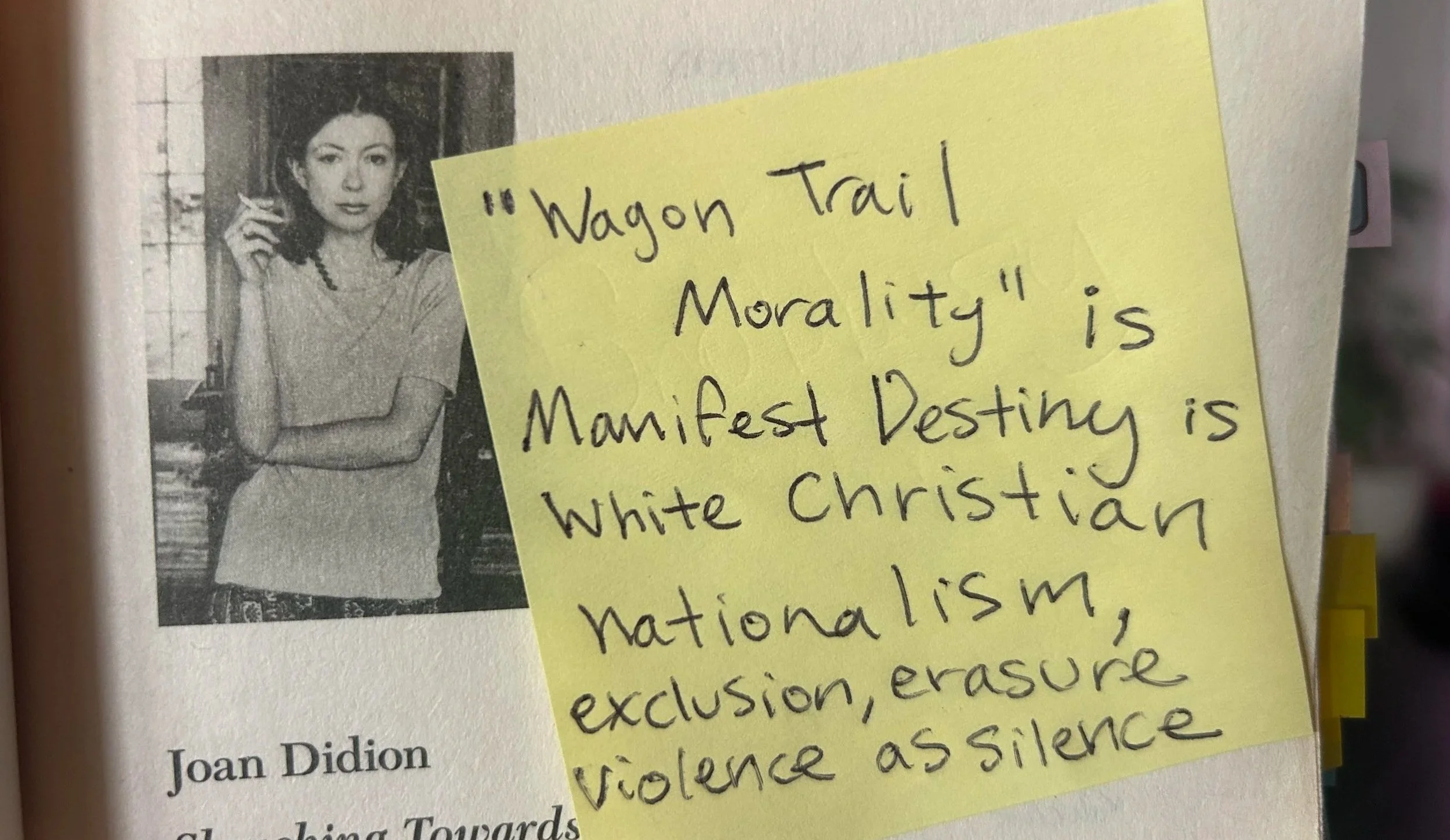
This will be the last time I write about Joan Didion. I just need to purge her ideology and the experience of studying her from my system.
I question the character of Mexican horticulturist Amado Vazquez, considering he named an orchid after Joan Didion. Myriam Gurba mentions him in the section titled “The White Onion” of her 2023 Creep, which critiques Didion’s racial grammar and the silenced Native American and Mexican voices that haunt her work. She is one of the few writers willing to critique Didion and the white literary establishment for positioning her as a prominent California writer. Reading Gurba refer to Didion as the “windy bitch” felt great. Gurba validated my feelings of exclusion as I studied Didion’s “wagon trail morality” at UCLA, meaning her inherited white settler ideology that guided her viewpoint throughout her work. It was in academia that I was exposed to just how widely Didion is still embraced, as multiple California literature professors at UCLA continue to include her in their syllabi and celebrate her work like fan-girls instead of critically analyzing her perspective in the classroom. She also still influences how California’s communities are perceived by her mostly white elitist fan base throughout the US, which is the last thing we need in our current political climate. This is not to say all her readers are pretentious snobs. Some are just not willing to deal with the reality of the text, the evil of banality, and the silencing of Communities of Color. Some of her fans are boring people going with the flow of whatever is popular. To protect their reading experience, and maybe to protect their respect for Didion, they ignore the exclusionary sense of superiority in her work.
I took the course, excited to learn about her writing style, but by the end, I understood she was deliberately looking down her nose at working-class communities and silencing California’s original ancestors. Silencing is violence, and her prose perpetuate the violence that California native communities have historically faced due to white settler ideology. She even wrote against the Black Power and the Women’s Liberation movement of the 60s, and any counterculture that she felt was eroding the values of her white ancestors. When I was studying her work and ideology, the professor presented her 2003 novel, Where I Was From, as a rejection of the problematic ideology that guided her viewpoint in previous narratives, but after analyzing it, I felt the professor was reaching for an apology that the narrative did not present. Not that I need Didion to care enough to apologize. To hell with the dead “windy bitch.” But as a Chicana who was born and raised in East Los Angeles, who understands the violence of silencing underserved communities, I am unwilling to follow the herd of writers who admire and emulate her. I wish I could allow myself to learn from Didion the way Gurba and friends of mine have, but I refuse. My aim is not to offend her fans nor to say she should not be read, but to ask that her work be read more critically and be seen for what it is. I will refer to the narrating persona of Where I Was From rather than Didion directly as I critique the narrative so as not to further offend her fans.
In Where I Was From, the narrating persona reflects on California as a frontier promised land of self-sufficiency and on its cultural drift away from white settler ways. In its position as a descendant of settlers, the persona fuses its inherited story, memoir writing, and the region’s civic and economic history to explore the community of Lakewood, California, as an example of the erosion of settler values. The Central Valley is also explored for its agricultural holdings early in California history. These two communities are critiqued by the persona for their dependence on the federal government and other systems of power. Through the fusion of writing techniques, the persona confronts the contradictions between the idea of California as an independent community and its dependence on federal aid through analysis and reflection, but while the lack of self-reliance in Lakewood and agricultural communities is made evident to some degree, it does so from an elitist perspective that looks down on families and communities in need of federal assistance using a lens anchored in white settler ideology. Thus, the “we” being critiqued is the “we” within the inherited lineage the persona occupies, functioning as an instrument to expose contradiction, and as a conduit for white settler ideology. The reflection does not reject the settler narrative that created the systems being critiqued; the persona does not confront it directly. Instead, settler ideology shapes the narrative, exposing contradictions but marginalizing underserved communities along the way.
The reflective persona speaks with authority as a descendant of California’s settler community, offering archival evidence of its family history.
My great-great-great-great-great-grandmother… was remembered to have hidden in a cave with her children… during Indian fighting…. her husband was said to have killed, not counting English soldiers or Cherokees, ten men. I have it on the word of a cousin who researched the matter that… our great-great-great-great-greatgrandfather, “appears in the standard printed histories of Arkansas as Old Colonel Ben Hardin, the hero of so many Indian wars.’” (p 9)
Here, family history is used as a tool for the memoir component of the narrative, establishing credibility through ancestry, providing a sense of belonging for the persona, and serving as evidence for arguments against contemporary California. The family is described as self-sufficient heroes who bravely protected their children in caves against Native American hostility. Natives function only to represent frontier violence in this passage and throughout the text. A community with historical roots deeper than those of the white settler on California soil is reduced to a violent obstacle that only appears in the background of Where I Was From. Didion’s persona uses them as a tool to heighten the hardships the settlers faced, not as part of the frontier community with an important history of their own. This reproduction of the exclusionary settler narrative has a heroic tone, keeping Indigenous people as outsider enemies from the persona’s family history and national identity.
The narrative shifts from a settler memoir to an analytical interrogation, framing the community of Lakewood as an example of the erosion of white settler self-reliant perseverance. A series of questions are posed regarding the community’s socioeconomic status: “What does it cost to create and maintain an artificial ownership class? Who pays? Who benefits? What happens when the class stops being useful? What does it mean to drop back below the line?” (p 98). These questions imply that systemic forces handed the community over to people who did not earn it. The persona identifies the suburban residents of Lakewood as an “artificial ownership class” who did not deliberately work to build the community and system they live in, but were granted access to a status or “class” they did not achieve, and cannot understand how to maintain the status without assistance. This suggests that those who build their communities from the ground up earned their “class” and are above those who depend on the federal government. The other questions further imply that the stability of the community depends on external sources that made homeownership possible, such as the federal government, the military, and industrial complexes. The question “What happens when the class stops being useful?” suggests the community would become a burden once the systems that helped them are no longer available, but a burden on whom? This question reframes the idea of an economically strong community that the middle class was historically perceived as, to an unstable environment. After this interrogation, the persona shifts to critiquing Lakewood’s Spur Posse, a gang of misguided sexually predatory teenage boys, and their lack of education, using them to highlight the consequences of financial dependency and social decline. This section of the narrative attempts to reveal a lack of independent prosperity in the Lakewood community. However, the lens through which the persona interrogates and the way the questions are posed reflect a sense of superiority. The idea of California as a self-sufficient state is probed by the interrogation of this community, but the argument rests on settler ideology, which it does not directly challenge. Instead, it is used as a marker of how people should live, limiting what is perceived as community and the persona’s critique.
The collective “we” is an important tool throughout the narrative, keeping the persona part of the California community, while perpetuating settler ideology. “In California we did not believe that history could bloody the land, or even touch it” (p 64). There is no distance here between the persona and California’s supposed shared detachment from its historical settler violence. “In California we” implies that everyone in the California community shares the persona’s detachment that keeps Communities of Color that contribute to California’s history and community silent. This way of thinking belongs to the white Californians whose families migrated to the West and saw California as an open territory free of the burdens of history, focusing on the illusion of progress while ignoring the reality of their actions. Essentially, this way of thinking is erasure. It allows the settler narrative of expansion to be seen as natural rather than violent forced displacement. Although the persona recognizes the need to interrogate California, it continues to speak through its inherited settler identity. With the collective “we,” the persona perpetuates exclusionary settler ideology while shining a light on contradictions, but not outright displacing the ideology from which the system critiqued evolved.
The narrative contributes to the continued erasure of historically marginalized communities. Out of 199 pages, only a handful contain brief mentions of farm workers who are known to be primarily of Latine origin: “Their relationship to the land is as casual as that of the migratory workers they employ” (p 51). This line is one of the few in which farm workers are mentioned in a narrative that seeks to critique California’s agricultural system. Here, farm workers are referred to as migrant workers, assuming they have no roots in California. Cesar Chavez is quickly mentioned later in the text. The role of farm workers is minimized in the agricultural system, while the persona focuses on federal policy, such as the Reclamation Act and the power of wealthy landowners, deliberately ignoring the contributions of farm workers to make the case that the region did not work for what they were given. It is true that the act gave federally owned lands to California for farming, which were initially manipulated to be designated as swamp land, lowering their value. Meaning wealthy ranchers bought up the land, expanding their ownership through legal manipulation and not labor. But the persona’s analysis reveals federal dependency while minimizing the contributions of farm workers and small farms who help sustain agricultural wealth and are not given handouts. Contradictions between California’s dependency and the settler ideology of self-sufficiency are revealed, but the persona speaks as a settler descendant focused on those in power, leaving a multitude of Californians outside of the collective identity, such as those it labels as migrant workers in this section and “Indian” in others.
An interesting observation that reveals the persona’s exclusionary settler perspective and racist grammar Gurba wrote about is its choice of language when referring to Native Americans. While in a few instances the persona refers to Native Americans by their tribe, such as Cherokee, the term “Indian” appears a total of 32 times in the narrative: 12 of the references are made by the persona to refer to an Indigenous person, and 21 times within quoted sources. Native Americans are referred to as “native” once by the persona, but only when referring to them as “native Digger Indians,” which is a negative stereotype, and 3 times to refer to white people. The persona never refers to Native people as Indigenous or Native Americans, positioning them outside a space of belonging, using “Indian” as a way to distance them from California and American identity. The use of exclusionary and othering settler language in a modern text highlights the dominant viewpoint throughout the text, which views Communities of Color, including farm workers and Indigenous people, outside of the communal perspective of the persona. The result is the continued marginalization of People of Color in a modern narrative, while the dominant viewpoints are reinforced.
The consequence of exclusionary narratives matters beyond the historical moment of settler expansion. Historical narratives retold through the inherited settler lens and used to critique contemporary communities shape how those communities are perceived in a modern context. Due to our current political climate, it is of the utmost importance to recognize the violent colonizer mentality and its silencing ways and not perpetuate the ideology or praise it. In the case of the Lakewood community, the settler ideology of self-sufficiency served as an elitist perspective from which to analyze and perceive the community as dependent on a system that conferred a social class they did not earn. Similarly, federal handouts in the form of farmlands to wealthy California ranchers and farmers are interpreted as a drift away from frontier autonomy, ignoring the contributions of farm workers and small farms, who were not given handouts. While the persona interrogates these communities, the perspective remains fixed on a historical settler identity, heroically reproduced as the persona’s family background and invoked as evidence of the inherited authority. Within this ideological framework, the persona decides who is seen and belongs to the presented California community. The profusely used term “Indian” marginalizes Native Americans and keeps them outside the boundary of belonging that the persona perpetuates. Along with the use of marginalizing language, the exclusionary settler ideology makes natural the idea that California is untouched by historic violence without a firm challenge and stance, only to be highlighted and reproduced. The fact that this text was published in 2003 means the narrative has contemporary consequences, as Didion still has influence over how California is perceived when read for leisure or in a university setting, where students read her work as instructional. Without deep analysis outside of the settler ideology and a strong critique that does not avoid confrontation, the erasure of narratives central to California’s history and community becomes normalized and accepted. Although the text interrogates a lack of self-sufficiency, the limits to belonging throughout the text are set by the inherited settler ideology that created the boundaries in the first place and remain unchallenged. Contrary to what my professor said, the narrative was never meant as an apology for the ideology that permeates Didion’s earlier texts. Cracks are revealed in California communities through the fragmented narrative structure and settler lens, but at the expense of communities that have long suffered due to exclusionary narratives. Knowing our history and sharing our viewpoint is important, but equally important is the lens through which we analyze the past and reproduce our story.
