Undergrad Observations: UCLA Signs and Campbell Hall
Written on 2/20/2026 when I was attending UCLA as an undergrad. The website template does not let me change the date…
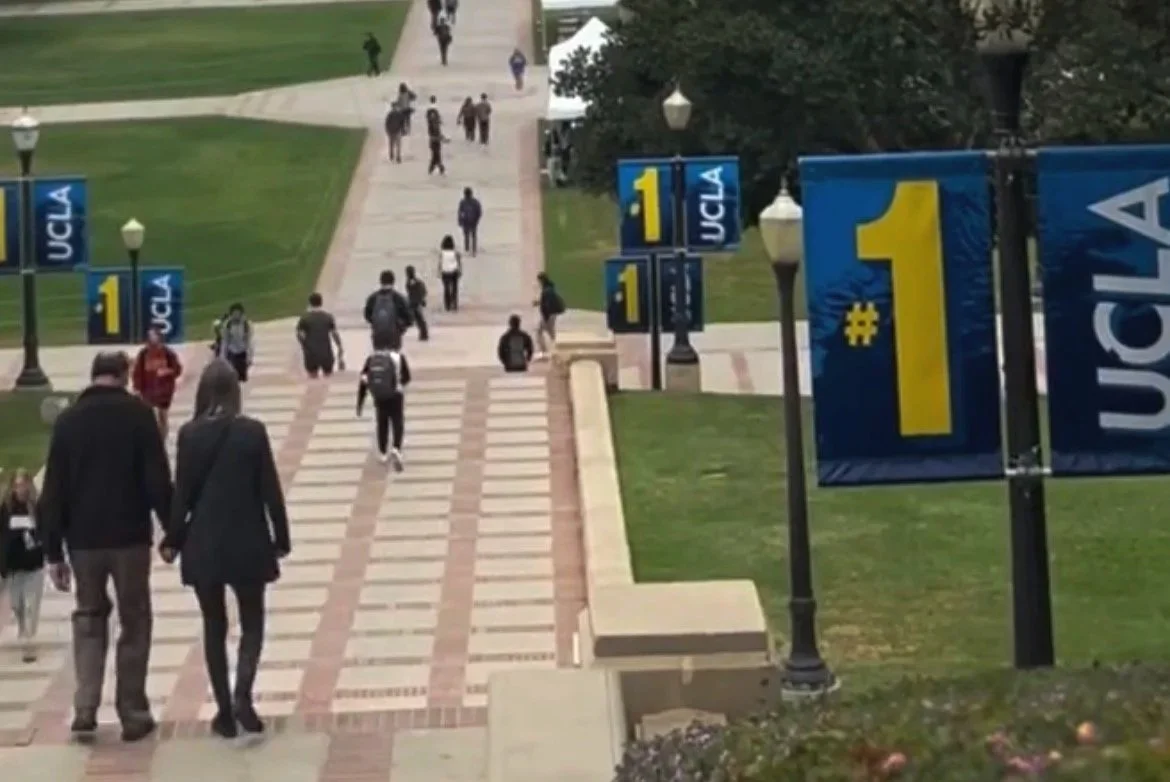
I remember reading Joan Didion in my teens, when I knew less and cared for nothing. The impression she left on me then was part of the driving force behind my curiosity to revisit her 26 years later with a new critical lens I’ve developed as an English major, but the more I read her and recognize her elitist detachment, a product of her white privilege and praised “wagon trail morality,” the more I become fixated on things that feel newly unsettling. At first, I became bothered by the trivial, like students finding her detachment “refreshing,” and that a significant number don’t flush the toilet. Then I became more bothered by the way the university displays its UCLA propaganda every few feet throughout the campus. My first year as a transfer, the banners read something like “UCLA, We are #1.” Walking past them, I’d think of my dad telling me that no one with a big ego could ever give me wings. It was not long before Cal reclaimed its title, and the #1 banners were replaced everywhere with a generic UCLA design. I celebrated the fall from #1 privately. It turns out I’m not the only one confining themselves. Bruin politics are for the bathroom stalls, where you’ll find support and opposition to Trump and Palestine. While the banners, graffiti, and the elitist detachment in some of the classrooms are troubling, I find that what the university keeps quiet is much worse. In the heart of the campus is a site that doesn’t make it on the tour, Campbell Hall, where students Alpertice “Bunchy” Carter and John J. Huggins, Jr. were assassinated.
I almost missed the building entrance the first time I looked for the McNair Research program’s office in Campbell because a temporary utilitarian white bungalow was in the way. Campbell is not as striking as the buildings on the quad, but the main entrance still has a monumental feel, with steps designed for giants. The building makes me think of the courthouses in Downtown LA, which is disconcerting considering its history with injustice. Before the main entrance, to the right of the front steps, is a metal plaque indicating handicap access. It is opaque and a soft copper color, new-looking compared to the building it is fixed to. Next to the top of the steps, in the dirt of a landscape bed, is a small boulder with the names of Carter and Huggins engraved on it.
I learned about the assassinations of Carter and Huggins years ago through Amy Goodman, a journalist for Democracy Now. Unlike Didion, I was impressed by their efforts as student leaders in the Black Power movement. The two non-traditional students were among the first to be admitted to UCLA’s High Potential Program, which is now AAP and still headquartered on Campbell’s 1st floor. Historically, the program provided resources to underrepresented students. In what was supposed to be a safe space of belonging, Carter and Huggins attended a Black Student Union meeting where they were shot as a result of FBI disruption within the Black Power movement. As someone with close ties to organizers and activists in LA, I know how easily communication breakdowns happen when the stakes are high and the community is passionate, as did the FBI. Carter and Huggins were up against the systemic power that AAP and other programs in Campbell are meant to help students navigate. As a non-traditional, AAP McNair student myself, who cares deeply about Communities of Color, I know how alone Carter and Huggins were on campus, even with the supposed mentorship and support. People like us can’t afford to detach.
Inside Campbell, next to the wooden-trimmed AAP information window to the right of the main entrance, is a glass and plastic display box with announcement flyers pinned inside. On the opposite wall is the same drab display box, but instead of flyers, it holds a DIY plaque honoring the slain students. It was installed in 2010 along with the boulder, without the university’s approval. Under the names of Carter and Huggins reads “Lest We Forget, In this building on January 17, 1969 two UCLA students, members of the Black Panther Party, were slain in the ongoing struggle for student empowerment and social justice. Educate to Liberate.” The letters are white vinyl stickers that stand bright on a black gatorboard in the dim hall. Campbell Hall is always dim, even when all the lights are on. Perhaps the checkered flooring and walls painted half dark green, pretending to be wainscoting, suck up the light. The clear push pins look tired of holding up the gatorboard, which is a sturdier kind of foamboard, at least. I don’t know what to think of the lock on the display box; it doesn’t give it any permanence. The handicap sign outside feels more secure and official. Perhaps the students who worked on the Powell Cat memorial in brass last year could work on something in honor of these assassinated fellow Bruins. I cringe thinking of the brass cat perched on a pedestal in Kerckhoff Hall. The endeavors we commit to speak volumes about our character.
Over the summer last year, philosophy graduate student and McNair mentor Courtney Minor installed a wall-mounted screen in Campbell. The screen now displays AAP and various program announcements, events, and updates, but even with the modern touch, Campbell’s 1st floor feels like East LA’s Garfield High School to me, a place where very young Students of Color try to work past their very adult problems. AAP and McNair do their best to brighten up the halls with colorful photos and affirmations, but the attempt to uplift the students feels tragic next to the black gatorboard and the small boulder.
